Topical wellness products have changed considerably over the past few years.
Traditional muscle rubs and cooling gels are still popular, but consumers now have more options than ever. CBD creams, salves and balms have become particularly visible as people look for products they can apply directly to specific areas of the body.
For someone shopping for a CBD topical, however, the choices can quickly become confusing.
Should you choose a cream or a balm? How much CBD should it contain? What’s the difference between warming and cooling products? And does a higher CBD concentration necessarily make a product better?
Understanding a few basics can make comparing these products much easier.
Why People Choose Topical CBD Products
One of the biggest differences between topical CBD products and products such as CBD oils or gummies is how they’re used.
A topical is applied directly to the skin.
This makes creams, balms and salves particularly appealing to people who want to incorporate CBD into a targeted wellness or recovery routine.
Someone might apply a topical after working in the yard, exercising, spending a long day on their feet or simply as part of an evening massage routine.
The experience can vary significantly depending on the formulation.
Some CBD topicals are relatively simple moisturizing creams. Others combine CBD with ingredients that produce warming or cooling sensations.
CBD Cream vs. CBD Balm
Although the terms are sometimes used interchangeably, creams and balms aren’t necessarily the same thing.
CBD creams typically contain water along with oils, emulsifiers and moisturizing ingredients. This can create a lighter consistency that spreads easily across the skin.
Balms and salves are generally more oil- or wax-based. They tend to have a thicker consistency and may remain on the skin longer.
Neither format is automatically superior.
Some people prefer the lighter feel of a cream, while others like the thicker consistency of a balm or salve.
The formulation matters more than the name printed on the container.
Why Nerve Comfort Has Become a Popular Topical CBD Topic
One area receiving increasing attention is the use of topical products as part of routines focused on nerve-related discomfort.
People searching for these products frequently encounter creams, balms and gels marketed for targeted application to areas such as the feet, hands, legs and lower back.
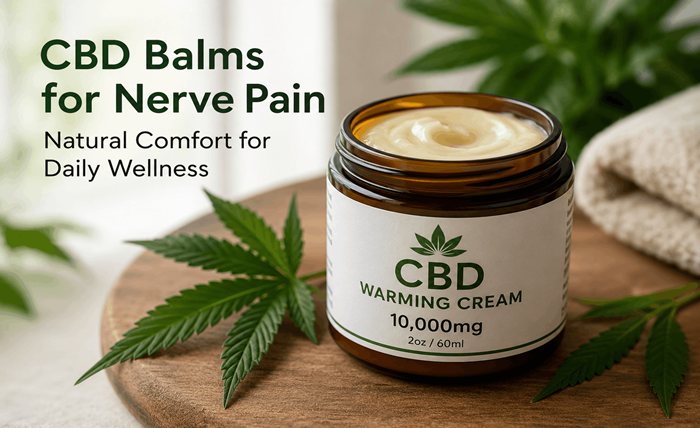
Consumers researching a CBD balm for nerve pain may also notice that some newer formulations combine high concentrations of CBD with warming or cooling ingredients designed to create a noticeable topical sensation.
It’s important to distinguish that sensation from the CBD itself.
For example, menthol can produce an immediate cooling feeling, while other ingredients may create warmth. Those sensations can be present regardless of the CBD concentration.
That’s why consumers should evaluate the complete formulation rather than focusing on CBD alone.
Warming vs. Cooling CBD Topicals
Warming and cooling products can create very different experiences.
Cooling CBD creams frequently contain menthol or similar ingredients. Menthol activates sensory receptors in the skin, producing its familiar cooling sensation.
Warming products use ingredients formulated to create a warming sensation after application.
Some products combine the two experiences, producing an initial cooling sensation followed by warmth or vice versa.
Personal preference plays a significant role here.
Someone who enjoys the sensation of traditional mentholated muscle rubs may prefer a cooling CBD cream, while another person may find a warming formulation more comfortable.
CBD Potency Varies Enormously
CBD concentration is another major difference between topical products.
The market includes everything from relatively low-potency lotions containing a few hundred milligrams of CBD to concentrated creams and salves containing several thousand milligrams.
However, consumers need to pay attention to container size.
Consider two hypothetical products:
One contains 2,000 mg of CBD in a one-ounce container.
Another contains 2,000 mg in a four-ounce container.
Both advertise “2,000 mg CBD,” but the first product is substantially more concentrated.
Looking at CBD content relative to the total product size provides a much better comparison.
Higher Potency Isn’t the Only Consideration
The rapid growth of high-potency CBD products can make it tempting to simply purchase the product with the largest number on the label.
That’s not necessarily the best approach.
CBD concentration is only one factor.
Consumers should also consider:
- Container size
- Complete ingredient list
- Type of hemp extract
- Warming or cooling ingredients
- Fragrance
- Texture and consistency
- Third-party laboratory testing
- Manufacturer transparency
A well-formulated product should provide enough information for consumers to understand what they’re applying to their skin.
Look at the Other Ingredients
Topical formulations frequently contain ingredients that have a substantial effect on the experience.
Menthol is perhaps the easiest example because its cooling sensation is immediately noticeable.
Other products may contain aloe vera, botanical extracts, essential oils, moisturizers or other ingredients.
People with sensitive skin should be particularly careful.
Just because an ingredient is plant-derived or described as “natural” doesn’t guarantee that everyone will tolerate it.
Checking the complete ingredient list and testing a small area of skin before broader use can be sensible precautions when trying a new topical.
Third-Party Testing Is Important
CBD consumers should also look for independent laboratory testing.
A certificate of analysis, commonly called a COA, can provide information about the cannabinoid content of a CBD product.
Depending on the testing performed, laboratory reports may also include screening for contaminants such as heavy metals, pesticides or residual solvents.
Testing becomes especially important as CBD concentrations increase.
If a company advertises a particular amount of CBD, consumers should have some way of verifying that the product contains approximately what the label claims.
Keep Expectations Realistic
CBD has attracted substantial interest, but consumers should be cautious about exaggerated medical claims.
Research into cannabidiol continues, including research involving discomfort and various neurological conditions, but that doesn’t mean a topical CBD product has been proven to treat or cure nerve disorders.
CBD topicals shouldn’t replace medical evaluation or prescribed treatment.
Persistent burning, tingling, numbness or nerve pain can have numerous causes, and anyone experiencing these symptoms should consider discussing them with a qualified healthcare professional.
Choosing the Right Topical Comes Down to the Details
There is no single CBD cream or balm that’s appropriate for everyone.
Some consumers want an unscented everyday cream.
Others prefer an intense cooling sensation after physical activity.
Some specifically seek high-potency products, while others are more comfortable starting with lower concentrations.
The best approach is to look beyond the marketing on the front of the container.
Consider the CBD concentration, container size, complete ingredient list, formulation, laboratory testing and how the product is intended to be used.
As CBD topicals continue evolving, consumers have more choices than ever.
Understanding those differences makes it much easier to choose a cream, balm or salve based on the characteristics that actually matter to you.